
Discovering that your dog has a torn/ruptured cranial cruciate ligament (CCL; termed anterior cruciate ligament/ACL in humans) can feel overwhelming. The internet is flooded with conflicting advice on conservative/non-surgical options and different surgical options for the affected pet.
As an ACVS board-certified veterinary surgeon whose most common surgery is the Tibial Plateau Leveling Osteotomy (TPLO), I want to cut through the noise. If your dog was recently diagnosed with a CCL rupture, here is the honest, clinically proven reality of what you are facing, what to expect, and why TPLO remains the definitive solution.
Shifting Your Perspective on the Diagnosis
It is completely natural to feel anxious about putting your dog through orthopedic surgery. When I consult with a client whose dog has just been diagnosed, the very first thing I tell them is this: TPLO is the gold standard surgical approach for a CCL rupture, and it carries a good to excellent prognosis for returning your dog to the same level of athletic activity they enjoyed before the injury.
The Biomechanics: Why the Injury Happens and How TPLO Fixes It
To understand why the TPLO is so effective, it helps to understand your dog’s anatomy. The CCL in dogs serves the same purpose as the ACL in humans, stabilizing the stifle joint (same as the human knee) by connecting the caudal (back) aspect of the lower femur to the dorsal (front) aspect of the joint surface of the tibia.
Unlike humans, dogs naturally have a tibial joint surface that angles downward from front to back, known as the tibial plateau angle (TPA). In dogs, osteoarthritis in their stifle joints appears to be a primary factor leading to CCL ruptures, possibly from the presence of inflammatory enzymes in the joint that weaken the ligament. When the CCL ruptures, there is no longer a brake to hold the joint in place. The femur constantly slides backward down that angled tibial slope every time your dog takes a step, causing continued pain, instability, and further joint damage.
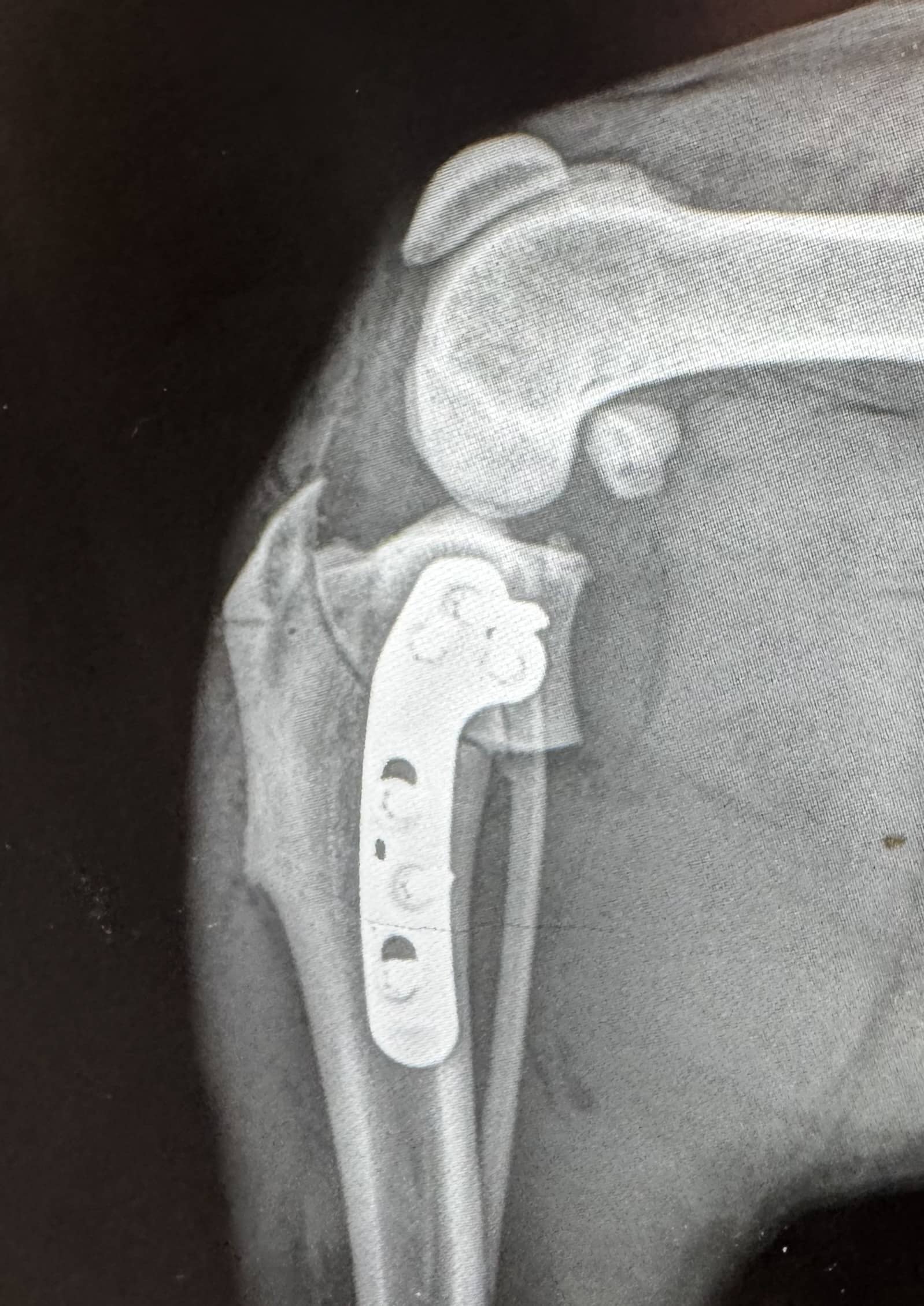
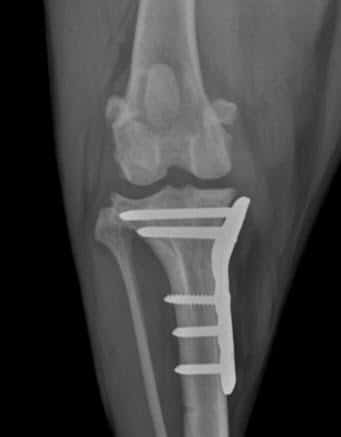
The TPLO procedure addresses this mechanically rather than trying to repair a ligament with limited healing ability by the following steps (see figures):
- The Radial Cut: A semicircular cut is made in the top of the tibia using a specialized radial saw blade made specifically for TPLOs
- The Rotation: The upper fragment of the tibia is rotated a specific distance, calculated using precise computer software to flatten the joint surface.
- The Stabilization: By creating a virtually flat tibial joint surface, the femur can rest stably on the tibia without sliding backward. The rotated bone is secured permanently using an orthopedic TPLO plate and screws (see figures), preferably using locking plate technology.
Debunking the Alternatives: Small Dogs, Conservative Management
A common misconception is that every dog with a ruptured CCL requires a TPLO or that non-surgical options are highly effective. The data tells a different story.
The Extracapsular Suture Technique
For dogs weighing under 20 to 25 pounds, the extracapsular suture technique remains a viable surgical option. It is less expensive than a TPLO, effective when there are no complications (i.e., suture failure), but it does carry a higher rate of surgical failure. For dogs over 25 pounds, the extracapsular technique is generally not recommended due to an unacceptably high failure rate. I still give this option to all owners with smaller pets (under 20 pounds).
Conservative/ Non-Surgical Management
Many non-surgical alternatives to the TPLO are discussed online. It is important to realize that, biologically, a completely torn CCL has negligible healing capacity. Thus, the CCL is not likely to heal and the stifle joint is likely to remain unstable with any of the alternatives to surgery (although braces can be valuable to provide temporary limb stabilization prior to surgery or for periodic use in dogs not treated surgically, neither braces nor long term rest are likely to result in ligament healing). The marked efficacy of the TPLO is due to the fact that joint stabilization is achieved independent of the CCL.
Inside the Recovery Window: Pain, Stability, and Infection
The immediate postoperative period is often the primary source of owner anxiety. Modern surgical advancements have dramatically improved this experience.
Revolutionizing Pain Management
Pain control during the critical first 72 hours has been transformed by Nocita, an injectable local anesthetic placed in liposomes that slowly releases medication into the surgical soft tissues over that time period. I will not perform a TPLO without Nocita due to its immense efficacy in improving the patient’s comfort. While individual responses vary, Nocita allows the majority of dogs to sleep comfortably for the critical first three nights.
Once home, this is paired with non-steroidal anti-inflammatory drugs (NSAIDs) such as carprofen or meloxicam to target pain and inflammation, alongside calming medications including gabapentin and trazodone to keep your dog rested.
Implant Stability
Clients often worry about the surgery failing. Thanks to modern locking plate technology, the surgical fixation is incredibly stable. If performed correctly, the chance of implant failure after surgery is negligible with this technology.
Managing Infection Risks
While infection of the surgical site or metal implants is a serious concern, the actual incidence is very low in a dedicated surgical suite managed by well-trained surgeons and technicians utilizing strict scrub protocols, proper aseptic techniques, and intraoperative intravenous antibiotics.
It is still critically important to prevent your dog from licking the surgical site to avoid infection. New options including the Lick Sleeve can be used alongside traditional E-collars to decrease the chance of your dog harming the incision.
Looking Ahead: The Opposite Leg and Long-Term Care
Once the bone has successfully healed, exercise restriction ends. We perform this surgery specifically to let your dog return to their normal lifestyle. However, you must keep the big picture in mind.
Statistically, there is approximately a 50% chance that the CCL in the opposite hind limb will rupture, most commonly within the first one to two years following the initial injury (and sometimes when the dog is recovering from the first TPLO). If a rupture occurs in the second leg, it is most likely due to the same pre-existing osteoarthritis in that stifle that led to the first rupture in the opposite stifle.
The best long-term management strategy to protect both stifle joints includes:
- Strict Weight Management: Weight management not only decreases the stress on the remaining CCL, but also alleviates pressure on arthritic joints.
- Anti-Inflammatory Therapy: Although the TPLO surgery effectively addresses the structural instability in a stifle with a CCL rupture, the joint (and likely the other stifle joint) will still have osteoarthritic changes. Thus, whereas many dogs are sound without NSAIDs (i.e. carprofen or meloxicam) after a TPLO (at least for several years), some dogs need to be maintained on NSAIDs due to the degree of osteoarthritis present.
- A Note on Joint Supplements: Due to a lack of robust scientific evidence proving that nutraceuticals containing glucosamine or chondroitin sulfate actively improve or halt arthritic changes in dogs (and fairly consistent scientific evidence that they do not have a positive effect on arthritic changes or pain in dogs or humans), I do not promote or recommend these products to my clients. There are scientific data to support the addition of Omega-3 fatty acids (specifically EPA and DHA from fish oil) to the diet of osteoarthritic dogs.
The cost: Why is there such a range in what clinics charge and why is the surgery so expensive?
- While the cost can feel overwhelming, it reflects a highly specialized surgical procedure using costly human-grade orthopedic equipment (orthopedic saws and drills) and surgical grade implants. Surgeries performed by board-certified veterinary surgeons can be more expensive; however, you are investing in elite surgical training commonly followed by years of surgical specialty experience for your dog’s care. Due to the complexity of the TPLO surgery, you want to make sure that a veterinarian who is not board certified by the ACVS has obtained extensive training in TPLO surgeries and has an excellent track record for their TPLO patients. In addition to the cost of the orthopedic equipment and implants, total expense for surgery includes: diagnostic imaging before and after surgery, surgeon and technician time, state of the art antiseptic preparation (including human grade products such as 3M Duraprep surgical solution) and extensive disposable orthopedic drape packs for surgery, the use of state-of-the-art anesthesia and monitoring by trained professionals, intravenous antibiotics and IV fluid support including constant IV infusion of analgesic (pain killing) drugs during surgery, and injections such as Nocita to improve postoperative comfort. Many of these costs will increase the larger the dog is. Costs for TPLO vary immensely in different parts of the U.S. As a general rule in the Pacific Northwest, urban specialty hospitals may charge $6-9,000 for a TPLO due to many legitimate factors including high urban overhead; qualified surgeons and facilities in smaller metropolitan areas commonly charge $5-7000 for a TPLO. If you are finding the procedure being offered at a much lower cost than that, I would recommend verifying that the surgeon and staff are well trained (and constantly performing the procedure), using state of the art orthopedic equipment and implants (i.e. locking plate technology), and providing quality products and care such as multiple IV antibiotic infusions in the perioperative period, constant IV infusion of pain killers during the surgery, and the use of Nocita at the end of the procedure.
Final Surgeon’s Advice
If you own an average to large-sized dog (from 25 to well over 100 pounds) with a diagnosed CCL rupture, do not let conflicting online marketing distract you. Focus your energy and your funds on TPLO surgery. It provides an incredibly high success rate in the hands of a well trained, experienced surgeon, addresses a structural problem that is unlikely to heal with conservative therapy, and avoids the wasted time and expense of unproven conservative options. Your dog’s mobility and comfort are worth the definitive investment.
Last Point: Find an experienced surgical team that offers reliable after-hours communication—such as direct text access—so you have peace of mind through the entire recovery process.
If you’re in the northwest Washington area and are looking for a board-certified veterinary surgeon experienced in TPLO surgery, reach out today!
Jim Belknap
Veterinary Surgeon
Jim Belknap is a board-certified veterinary surgeon in northwestern Washington (Northwest Veterinary Surgical Services; email: belknap.16@osu.edu).